 EN
EN
 DE
DE  NL
NL  FR
FR  ES
ES  IT
IT  CS
CS  PL
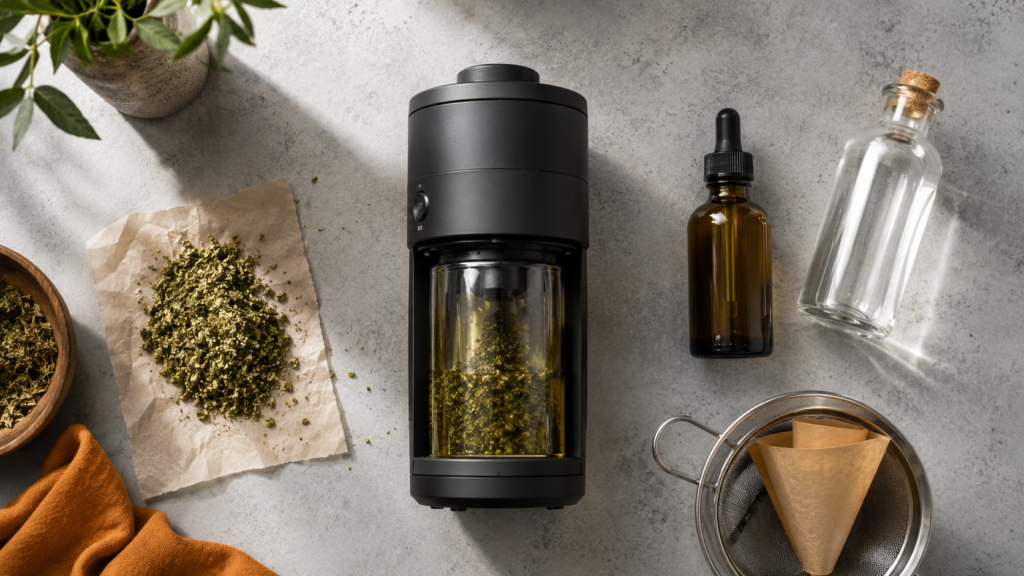
PL A cannabis tincture is an alcohol-based cannabis extract made by soaking decarboxylated cannabis in food-grade ethanol, then filtering the liquid into a bottle for measured use. With the NOIDS Herb Lab, the extraction stage can be completed in under two hours when the cannabis is already decarboxylated and your materials are prepared.
This guide explains how to make a filtered, concentrated cannabis tincture with the NOIDS Herb Lab, what to prepare before you start, how to think about potency, and how to store and dose the finished tincture carefully.
Important safety note: This article is for educational purposes only. Always follow local laws. Only use food-grade, non-denatured ethanol intended for consumption. Ethanol is flammable, so keep it away from flames, sparks, smoking materials, and unsafe heat sources.
What You’ll Learn
- What a cannabis tincture is
- Why decarboxylation matters before extraction
- What you need to make tincture with the NOIDS Herb Lab
- How the under-two-hour extraction workflow fits together
- How to filter, bottle, store, and estimate potency
- Common mistakes to avoid
What Is a Cannabis Tincture?
A cannabis tincture is a liquid cannabis extract made with alcohol. The alcohol acts as a solvent, pulling cannabinoids and other plant compounds from cannabis into the liquid.
Tinctures are usually stored in amber dropper bottles and measured by the millilitre or dropper. They can be taken directly, added to drinks, or used as an ingredient in some recipes.
A homemade tincture should not be described as pure or pharmaceutical-grade. Even after filtering, it may still contain plant compounds such as chlorophyll, waxes, terpenes, and fine particles depending on the cannabis, solvent, extraction time, agitation, temperature, and filtration method.
Before You Start
1. Decarb Comes First
Raw cannabis mostly contains acidic cannabinoids such as THCA and CBDA. Decarboxylation uses controlled heat to convert those acidic forms into THC and CBD.
Use the NOIDS Herb Lab decarb function or follow a controlled decarboxylation method before starting the tincture extraction. If your cannabis is not decarboxylated first, the tincture may be much weaker than expected for edible-style use.
Internal link: Complete Guide to Cannabis Decarboxylation
2. Use the Right Alcohol
Use only food-grade, non-denatured ethanol. Do not use rubbing alcohol, isopropyl alcohol, denatured alcohol, methylated spirits, or industrial solvents.
High-proof food-grade ethanol is commonly used for cannabis tinctures because it extracts cannabinoids efficiently. It is also flammable, so it must be handled carefully.
3. Know What “Filtered” Means
Filtering removes spent plant material and can reduce sediment. It does not purify the tincture in a pharmaceutical sense.
The finished tincture is still a homemade cannabis extract. Colour, flavour, and clarity can vary depending on the cannabis and extraction conditions.
4. Decide How Strong You Want the Tincture
A smaller amount of alcohol usually creates a stronger tincture per millilitre. A larger amount of alcohol creates a milder tincture per millilitre.
The right strength depends on:
- Cannabis weight
- THC or CBD percentage
- Final liquid volume
- Extraction efficiency
- Intended use
- Personal tolerance
For repeatable dosing, calculate potency before use.
Internal link: THC & CBD Potency Calculator
Quick Overview
- Method: Alcohol-based cannabis tincture
- Device: NOIDS Herb Lab
- Main function: Extraction
- Starting material: Decarboxylated cannabis flower or trim
- Estimated active work time: 10–20 minutes
- Extraction stage: Under two hours, depending on the selected Herb Lab setup and program
- Storage: Amber glass dropper bottle
- Best for: Measured drops, drinks, recipes, and later potency calculation
What You Need
Ingredients
- Decarboxylated cannabis flower or trim
- Food-grade, non-denatured ethanol
- Optional: small amount of fresh ethanol for adjusting final strength after filtering
Equipment
- NOIDS Herb Lab
- Herb Lab extraction setup
- Condenser, if required for the selected extraction setup
- Filter component or filter setup
- Amber glass dropper bottle
- Small funnel
- Label or marker
- Gloves
- Measuring cup or scale
- Optional: coffee filter for extra-fine filtering
Suggested Starting Ratio
For a small beginner-friendly test batch:
- 5 grams decarboxylated cannabis
- 50–100 ml food-grade ethanol
Use less ethanol for a stronger tincture and more ethanol for a milder tincture. The exact potency depends on the cannabinoid percentage of the cannabis, the amount of material used, extraction efficiency, and final liquid volume.
This ratio is a starting point, not a universal formula.
Step-by-Step: How to Make Cannabis Tincture with the NOIDS Herb Lab
Step 1: Decarboxylate the Cannabis
Start with cannabis that has already been decarboxylated. This may be done in the NOIDS Herb Lab or with another controlled decarb method.
Do not skip this step if your goal is an active THC or CBD tincture for edible-style use.
Step 2: Prepare the Herb Lab Extraction Setup
Set up the NOIDS Herb Lab according to the device instructions.
If the extraction setup requires the condenser, attach it before starting the process. Make sure all parts are correctly assembled and stable before adding alcohol.
Do not operate the device near flames, sparks, smoking materials, or unsafe heat sources.
Step 3: Add the Decarboxylated Cannabis
Place the decarboxylated cannabis into the Herb Lab container according to the device instructions.
Keep the material loose rather than tightly packed. The ethanol needs contact with the plant surface to extract cannabinoids evenly.
Step 4: Add Food-Grade Ethanol
Add enough food-grade ethanol to cover the cannabis fully.
The cannabis should be submerged, but you do not need excessive liquid. More ethanol creates a larger final volume and a milder tincture. Less ethanol creates a smaller final volume and a stronger tincture, as long as the cannabis remains properly covered.
Step 5: Run the Herb Lab Extraction Function
Start the Herb Lab extraction function.
The key message for the video and article is:
The NOIDS Herb Lab extraction function can turn decarboxylated cannabis into a filtered, concentrated alcohol-based tincture in under two hours.
This means the extraction stage can be completed in under two hours when the cannabis has already been decarboxylated and the materials are ready. If you still need to decarb first, total start-to-finish preparation time will be longer.
Step 6: Filter the Tincture
After the extraction cycle is complete, filter the liquid from the plant material using the Herb Lab filter setup.
For a clearer final tincture, filter again through a fine filter or coffee filter. This second filtration is optional, but it can reduce sediment.
Do not squeeze the plant material too aggressively if you want a lighter flavour. Heavy pressing can push more fine particles and bitter plant compounds into the tincture.
Step 7: Bottle and Label
Transfer the filtered tincture into an amber glass dropper bottle.
Label the bottle with:
- Date made
- Cannabis strain or material used
- Cannabis weight
- Estimated THC or CBD percentage
- Final tincture volume
- Estimated mg per ml, if calculated
This makes the tincture easier to use consistently later.
Step 8: Calculate Potency Before Use
Homemade tincture potency is always an estimate unless the final product is lab-tested. Still, a calculator gives a useful working number.
Basic estimate:
- Cannabis weight in grams
- Multiply by 1,000 to convert grams to milligrams
- Multiply by THC or CBD percentage
- Adjust for estimated process loss
- Divide by final tincture volume in ml
Example:
- 5 g cannabis
- 18% THC
- 5 g × 1,000 = 5,000 mg plant material
- 5,000 × 0.18 = 900 mg theoretical THC
- Actual usable THC will usually be lower after process loss
- If final tincture volume is 60 ml, divide the estimated available THC by 60 to estimate mg per ml
Use the NOIDS Potency Calculator for a more practical estimate.
Internal link: THC & CBD Potency Calculator
How to Use Cannabis Tincture Carefully
Start with a very small amount, especially if the tincture contains THC.
Tinctures can be used in different ways. A tincture held under the tongue may feel different from a tincture swallowed in food or drink. When swallowed, tincture behaves more like an edible because it passes through digestion.
Effects can take time to appear, especially when swallowed. Avoid taking more too soon.
Internal link: Edible Dosage Guide
Storage and Shelf Life
Store cannabis tincture:
- In an amber glass bottle
- Clearly labelled
- Tightly sealed
- Away from heat and light
- Away from children and pets
- Away from flames or ignition sources
- In a secure place where it cannot be mistaken for a normal drink or ingredient
Alcohol-based tinctures are generally more shelf-stable than water-based preparations, but quality can still decline with light, heat, air exposure, and contamination.
Common Mistakes
Skipping Decarb
If cannabis is not decarboxylated first, the tincture may be much weaker than expected for edible-style use.
Using the Wrong Alcohol
Only use food-grade, non-denatured ethanol. Never use denatured alcohol, rubbing alcohol, isopropyl alcohol, or industrial solvents.
Calling It Pure
A filtered homemade tincture is not the same as a purified or pharmaceutical-grade extract. Avoid describing it as pure. It may still contain chlorophyll, terpenes, waxes, and other plant compounds.
Using Too Much Ethanol
Too much ethanol can make the tincture unnecessarily weak per millilitre. It may still extract cannabinoids, but each dropper will contain fewer milligrams.
Over-Extracting
Longer is not always better. Longer extraction may pull more plant flavour, bitterness, colour, and chlorophyll.
Forgetting to Label the Bottle
Unlabelled tinctures are easy to confuse and difficult to dose. Always label the batch before storing it.
Guessing the Dose
Do not rely on “one dropper” as a universal dose. Dropper volume varies, and tincture strength depends on the batch.
FAQ
Can you make cannabis tincture in under two hours with the NOIDS Herb Lab?
Yes. The extraction stage can be completed in under two hours when the cannabis is already decarboxylated and the materials are prepared. This produces a filtered, concentrated alcohol-based cannabis tincture. It should not be described as purified or pharmaceutical-grade.
Do I need to decarb cannabis before making tincture?
Yes, if you want an active THC or CBD tincture for edible-style use. Decarboxylation converts acidic cannabinoids such as THCA and CBDA into their activated forms.
What alcohol should I use for cannabis tincture?
Use food-grade, non-denatured ethanol only. Do not use rubbing alcohol, isopropyl alcohol, denatured alcohol, methylated spirits, or industrial solvents.
Why is my tincture green?
Green colour usually comes from chlorophyll and other plant compounds. This is common in homemade cannabis tinctures and does not automatically mean the tincture is unsafe. Longer extraction times, warmer conditions, and heavy agitation can make tinctures darker and more plant-tasting.
Is a filtered cannabis tincture the same as a pure tincture?
No. Filtering removes plant material and can reduce sediment, but it does not make the tincture pure. A homemade tincture may still contain plant compounds extracted from the cannabis.
Can I use tincture in edibles?
Yes. Cannabis tincture can be used in some edible recipes, sauces, drinks, and infused preparations. Always calculate potency before adding tincture to a recipe.
How do I know how strong my tincture is?
Use the cannabis weight, cannabinoid percentage, estimated extraction efficiency, and final tincture volume to estimate mg per ml. For easier calculation, use the NOIDS Potency Calculator.
Related Guides
- Complete Guide to Cannabis Decarboxylation
- Cannabis Extraction Methods Guide
- Why Time Matters in Cannabis Extractions
- The Best Alcohol for Making FECO
- THC & CBD Potency Calculator
- Edible Dosage Guide
Looking for the device itself? The NOIDS Herb Lab, previously sold as the POT by NOIDS, has its own documentation page covering all five functions with their real temperatures and times, cleaning, and the beep and light codes.
 English